


At ESIC University, our social responsibility goes beyond academic training. As an educational institution committed to sustainable progress, we align our actions with the Sustainable Development Goals (SDG) established by the United Nations (UN). This commitment is essential to drive positive change in society. Although as an institution we work in various areas related to the 17 SDGs, we focus our efforts in a special way on the following SDGs:
In this section we present a series of initiatives and actions that demonstrate ESIC University's commitment to the Sustainable Development Goals (SDGs). The detailed evidence is in English, as this is the language required by the international institutions to which we report and are accountable each year, with the aim of collaborating in the measurement and monitoring of the global impact on the fulfillment of the SDGs.
LIFELONG LEARNING MEASURES
ESIC University, in its commitment to guarantee a quality, inclusive and equitable education, promotes opportunities for improvement following the roadmap set out by the SDG4, transforming its commitments into actions.
Free courses leading to certificate:
- #RelánsaT Project: ESIC offers free, certified training to people at risk of social exclusion, in collaboration with NGOs and through volunteers from the ESIC community. The courses are tailored to the needs of the participating groups and lead to a certificate of completion from ESIC University. The project’s webpage describes the groups it serves (women, young people, people over 50, prisoners, people with disabilities, among others) who are unemployed or in precarious employment. https://www.esic.edu/institucion/sostenibilidad/proyecto-relanzat
Free access to campus facilities and equipment:
- Library: Access to the ESIC Library is open to all individuals who meet the requirements set forth in the regulations. Students have access to both the study facilities and the available equipment, such as computers and an extensive collection of books and electronic resources. This provides them with a suitable environment for learning and academic development. https://www.esic.edu/institucion/biblioteca
Free access to online resources:
- ESIC Play: ESIC Play is a micro-learning app that offers free educational content on marketing, business, and technology, accessible to people outside the institution. Its public description describes the training as "100% free." https://apps.apple.com/us/app/esic-play/id6466413100
- #RelánzaT Project: The #RelánzaT Project makes audiovisual training content and PDF materials available to people outside ESIC, targeting small businesses, self-employed professionals, and unemployed individuals. The project uses resources produced by ESIC—available on ESIC Play and Rethink—along with materials developed by its volunteers. The materials on the project’s website cover marketing, sales, and communication; finance and legal matters; soft skills; and digital strategy and e-commerce. https://www.esic.edu/masesic/relanzate/contenidos-formativos
- Rethink by ESIC: Rethink by ESIC is a free, publicly accessible blog dedicated to knowledge sharing and learning, featuring articles on marketing, management, the digital economy, sales, and technology. Its content, written by professors from ESIC's campuses as well as external experts and professionals, offers explanations, analysis, and practical examples that can be read by anyone, regardless of whether they are enrolled at the institution. https://www.esic.edu/rethink
Ad hoc:
- Book presentations and outreach meetings: ESIC organizes one-time events related to publications on business and professional topics. One example is the presentation of the book *Empresas Magnéticas*, scheduled for September 17, 2026, from 6:30 p.m. to 7:30 p.m., in person at the ESIC Valencia campus (Avenida Blasco Ibáñez 55). The program focused on leadership, talent management, and employer branding, featuring the author and industry professionals. The event page includes a registration form (“Inscríbete en el evento”) that asks whether the registrant is an alumnus (yes or no). https://www.esic.edu/eventos/presentacion-del-libro-empresas-magneticas
The ESIC announcement invites attendees to an event featuring reflection and collective discussion based on an anthology of 28 perspectives on times of change, to be held at the ESIC campus at Avenida Blasco Ibáñez 55, Valencia. The event page includes a registration form ("Register for the event") that asks whether the registrant is an alumnus (yes or no). https://www.esic.edu/eventos/presentacion-del-libro-crisis-transformacion-evolucion
On a scheduled basis:
- ESIC Business & Marketing School Calendar: ESIC publishes a public calendar of activities featuring masterclasses and roundtable discussions, including the date, time, and location. The calendar on its website can be filtered by campus. https://www.esic.edu/eventos-esic-business-marketing-school
- IS MARKETING is an annual event organized by ESIC featuring talks and debates on marketing, business, and technology, with the participation of professionals and business leaders. The Madrid 2025 edition was held on April 3, in person at IFEMA Madrid, with registration open until capacity was reached, allowing people from outside the institution to participate. More than 20 editions have been held since the first one in 2004. Registration is done through a form on the event website, hoyesmarketing.com. https://www.esic.edu/dossier-hoy-es-marketing-2025
- Free ESIC masterclasses: ESIC's free masterclasses: the page invites visitors to select events and fill out a form to receive the access link; on the day of the event, they receive an email with the link. It features content on marketing, business administration (ADE), and communication. https://www.esic.edu/webinars-masterclass/grado
On a scheduled basis:
- Specialized courses for professionals: ESIC offers a program of short courses designed to develop professional skills in areas such as management skills, product management, and project management. The program includes both in-person and online formats, with course durations and start dates listed. Examples of short executive courses: Specialized Course in Management Skills and Specialized Course in Product Management (CEOPM). https://www.esic.edu/master-y-postgrado/executive-programs/business
Examples of short executive courses:
- Specialized Course in Management Skills: https://www.esic.edu/master-y-postgrado/curso-especializado-habilidades-directivas
- Specialized Course in Product Management: https://www.esic.edu/master-y-postgrado/curso-especializado-online-de-product-manager-ceopm
- Vocational training: ESIC offers a regular program of Higher Vocational Training Cycles (Ciclos Formativos de Degree Superior), taught in person. In Madrid: Marketing and Advertising, Administration and Finance, International Trade, Multiplatform Application Development, and Web Application Development. In Barcelona: Marketing and Advertising, Administration and Finance, and International Trade. The programs last two academic years (2,000 hours) and include on-the-job training at a company, focused on developing professional skills. Admission is open to candidates who meet the academic and admission requirements, without needing to be previously enrolled at ESIC. Example: Técnico Superior en Administración y Finanzas (Higher Technician in Administration and Finance) in Madrid. https://www.esic.edu/ciclos-formativos
Examples of vocational training programs:
- Higher National Certificate in Administration and Finance in Madrid: https://www.esic.edu/ciclos-formativos/grado-superior-administracion-finanzas-madrid
Ad hoc:
- Professional training workshops: ESIC organizes one-time practical training sessions for external professionals. One example is the in-person workshop “Your First AI Plan: Where to Start. Put AI to Work in Your Company” (Tu primer plan de IA, por dónde empezar. Put AI to work in your company), scheduled for September 23, 2026, from 9:00 a.m. to 11:00 a.m., at Foment-Gandía (Gandía). It was aimed at business owners, managers, department heads, professionals, and entrepreneurs interested in integrating artificial intelligence into their businesses, and its program covered the fundamentals of implementing AI in a company from both a strategic and practical perspective. The event page includes a registration form (“Inscríbete en el evento”) that asks whether the registrant is an alumnus (yes or no). https://www.esic.edu/eventos/taller-tu-primer-plan-de-ia-por-donde-empezar-pon-la-ia-trabajar-en-tu-empresa
Ad hoc:
- Educational workshops in the business community: ESIC Business & Marketing School collaborates with local organizations to conduct training activities off-campus. For example, AEDHE and ESIC organized a hands-on artificial intelligence workshop at the association’s headquarters in Alcalá de Henares (Calle Punto Net 4). According to the AEDHE announcement, the session took place on Tuesday, February 3, from 10:00 a.m. to 1:00 p.m., with registration via an online form. The activity featured live demonstrations, exercises, and participatory activities designed to teach the practical and responsible use of AI tools for productivity, communication, and work organization. https://aedhe.es/actualidad/aedhe-y-esic-business-marketing-school-organizan-taller-practico-sobre-inteligencia-artificial/
On a scheduled basis:
- Educational volunteering: Through MásESIC, ESIC’s volunteer group, students can participate in national projects throughout the academic year, including providing academic support to children with learning difficulties, accompanying children with cancer in hospitals, and offering marketing and communication advice to foundations. Its international volunteer program, which takes place in countries such as Ecuador, Venezuela, and Cameroon during the summer months, includes educational activities such as tutoring sessions led by students and professors. These initiatives extend ESIC’s educational activities to external groups and communities through the voluntary participation of its university community. https://www.esic.edu/alumni/mas-esic
- ESIC Code of Ethics: The Code of Ethics establishes the equal participation of people in all areas of the institution’s activities and a commitment to non-discrimination on any grounds. It also sets forth a commitment to providing educational opportunities accessible to all people, and extends these principles to relationships with stakeholders and to activities carried out with partner organizations. These provisions constitute the institutional framework used to ensure inclusive access to lifelong learning activities. https://www.esic.edu/themes/esic/pdfs/A4_CODIGO_ETICO_ESIC_2022.pdf
- ESIC Diversity Project: The Diversity Project complements the Code of Ethics through a framework of procedures, policies, and resources designed to promote equal opportunities and access to education. It expressly covers individuals who face discrimination on the basis of gender, race, ethnic origin, religion, or disability (functional diversity certified at 33% or more). Through the Diversity Technical Unit, it provides physical and technological accessibility measures, guidance, grants, and academic accommodations, and develops annual action plans integrated into ESIC’s Quality Policy. These measures demonstrate the practical application of the institution’s commitment to inclusion. https://www.esic.edu/institucion/proyecto-diversidad-esic-business-marketing-school
STUDENT ACCESS MEASURES
ESIC University is committed to achieving SDG5: Gender Equality, seeking to empower women and female students so that it has a multiplier effect, not only helping to promote economic growth, but also development at a global level, creating a fair and equal society.
ESIC tracks women's admission and enrollment rates every year. The data is collected during the admissions process and recorded in Salesforce; when applicants become students, their information is transferred to the student information system (SIS). ESIC's quality management system (Blu) then reports the gender breakdown of admitted students. For the 2024 academic year, covering ESIC University and ESIC Business & Marketing School, the report shows that 4,232 students were admitted to bachelor’s degrees and other higher-education programs, of whom 1,931 are women (46%); and 1,593 were admitted to master’s programs, of whom 912 are women (57.3%). The same report breaks down the figures by campus and shows the percentage of records lacking gender data, which is 0% in both cases.
Monitoring is supplemented by the annual program reports, which include information broken down by sex to identify and compare the participation of women and men and to analyze how it has changed by academic year and program. The 2024/2025 annual report for the Bachelor’s Degree in Business Administration and Management (Spanish- and English-taught groups), published on esic.edu, provides on page 6 the number and percentage of new students by sex for the last four academic years, with the ESIC University Registrar’s Office serving as the data source. On page 7, it comments on the trend: the proportion of men and women in the Spanish-taught groups remains stable compared to previous years, while in the English-taught group, women outnumbered men among new students in the last academic year (51.2%).
New students, Spanish-language group
| Academic year | New students | Women | Men | Women (%) |
|---|---|---|---|---|
| 2021–2022 | 136 | 30 | 106 | 22% |
| 2022–2023 | 101 | 21 | 80 | 20.8% |
| 2023–2024 | 91 | 22 | 69 | 24.2% |
| 2024–2025 | 103 | 24 | 79 | 23.3% |
New students, English-taught group
| Academic year | New students | Women | Men | Women (%) |
|---|---|---|---|---|
| 2021–2022 | 38 | 15 | 23 | 39.5% |
| 2022–2023 | 55 | 23 | 32 | 42% |
| 2023–2024 | 52 | 20 | 32 | 38.5% |
| 2024–2025 | 41 | 21 | 20 | 51.2% |
Example of a degree report: https://www.esic.edu/sites/default/files/2026-07/informe_anual_titulacion_grade_bbam_2024_2025.pdf. Page 6 lists the number and percentage of new students by gender. Page 7 discusses trends in male and female enrollment.


ESIC has a Specific Corporate Diversity Policy, which is part of its General Corporate Sustainability Policy, that expressly includes gender equality and applies to the educational community, including students and alumni. The policy establishes non-discrimination on the basis of sex, equal opportunities, and equitable treatment for those who study at or interact with the institution. It also provides for structures, tools, and procedures to ensure access to ESIC’s educational activities. It is implemented through programs, projects, and action plans, with a process of approval, monitoring, and annual review. In the policy document (pages 10 and 11), diversity includes gender equality, and the policy applies to the entire ESIC community: administrative and support staff, faculty and researchers, students, and alumni. Its first principle guarantees that no member of the ESIC community will be discriminated against on the basis of sex, among other grounds; the second promotes equal opportunities and equitable treatment for everyone who works or studies at the institution; the eighth commits ESIC to establishing the structures, instruments, and procedures necessary to ensure everyone’s access to its educational, research, and work activities. The policy is drafted by the Sustainability Department, reviewed by the Corporate Reputation Department, and approved by the Management Committee; it is reviewed annually. It explicitly refers to SDG 5 (gender equality) and to the principles of the Diversity Charter.
This framework is complemented by the Diversity Project, which includes welcome and orientation procedures for new students, scholarships and grants to facilitate access to education, and measures to support inclusion. The project page states that ESIC aims to provide education and promote social and labor inclusion for everyone, especially for people who face discrimination based on gender, race, origin, religion, or functional diversity. The project is national in scope, is led by ESIC’s General Secretary, and develops annual action plans that are integrated into ESIC’s Quality Policy; its Diversity Technical Unit carries out these actions.
Among the initiatives aimed specifically at women is the Women + Leadership Scholarship, which provides financial support to enable access to certain graduate programs. According to its website, ESIC’s Diversity Project uses this scholarship to support women’s contributions in the professional world: it covers 50% of the tuition (excluding the enrollment fee) for the Full-Time MBA, the International MBA, or the Executive MBA, and it is available nationwide.
Corporate Sustainability Policy: https://www.esic.edu/sites/default/files/2024-11/09%20POLITICA%20CORPORATIVA%20DE%20SOSTENIBILIDAD.pdf
ESIC Diversity Project: https://www.esic.edu/institucion/proyecto-diversidad-esic-business-marketing-school
Women + Leadership Scholarship: https://www.esic.edu/beca-mujer-y-liderazgo
ESIC offers financial support specifically designed to facilitate women's access to education. The Women + Leadership Scholarship covers 50% of the tuition, excluding the enrollment fee, for the Full-Time MBA, the International MBA, or the Executive MBA. The selection process takes into account academic merit, professional experience, and financial situation, among other criteria. ESIC’s scholarships page for master’s and MBA programs lists the full criteria (academic record, professional experience, financial resources, languages, and volunteer work) and the required documents, including a letter of admission to one of the three programs. If the scholarship is not awarded for one program, it can be transferred to one of the other two; it is available nationwide.
ESIC University's 2026/2027 Scholarships and Grants Plan includes the Beca Mujer STEM, developed in collaboration with Microsoft for the Bachelor's Degree in Computer Engineering. It covers 50% of the tuition for eligible candidates and aims to support the entry and retention of women in technology. On page 17, the plan describes it as an ESIC University initiative in partnership with Microsoft for women who wish to pursue their education and careers in science, technology, engineering, and mathematics (STEM), with the goal of promoting equal opportunities and reducing the gender gap in these fields. Applicants must have a grade point average of at least 7.50 in high school (Bachillerato) or advanced vocational training, and a committee selects them based on their academic and personal merits. Applications were open until June 30, 2026, through the Campus Virtual. The plan’s brochure states that the scholarship is exclusively for the Bachelor’s Degree in Computer Engineering.
Women + Leadership Scholarship — Scholarships and Financial Aid for Master's and MBA Programs: https://www.esic.edu/master-y-postgrado/becas-y-ayudas
The agreement between ESIC University and Microsoft Spain, announced on February 18, 2025, formalizes the earlier commitment to establish a scholarship to increase women's participation in this degree program. Microsoft's news center reports that, under the agreement, both institutions established a joint committee to create a scholarship aimed at boosting women's participation in the Bachelor's Degree in Computer Engineering, with the goal of reducing the gender gap in technology and increasing the presence of women in ICT.
ESIC University–Microsoft Agreement — Creation of a Scholarship for Women in Computer Engineering: https://news.microsoft.com/source/emea/2025/02/esic-university-y-microsoft-espana-se-unen-para-impulsar-el-nuevo-grado-en-ingenieria-informatica/?lang=es
Scholarship and Financial Aid Plan 2026/2027 — STEM Women Scholarship, page 17: https://www.esic.edu/sites/default/files/2026-04/becas-y-ayudas-nacional.pdf
ESIC University encourages women to apply for the Bachelor’s Degree in Computer Engineering through the Beca Mujer STEM scholarship, developed in collaboration with Microsoft. The initiative is specifically aimed at women who wish to study in this field and seeks to reduce the gender gap and support the entry and retention of female talent in technology disciplines. The scholarship covers 50% of the tuition for candidates who meet the academic requirements and pass the selection process. The “Beca Mujer STEM” section of ESIC’s 2026/2027 Scholarships and Grants brochure outlines the degree program, the purpose of the scholarship, the amount awarded, and the requirements: it is an ESIC University initiative exclusive to the Bachelor’s Degree in Computer Engineering, in collaboration with Microsoft, for women who wish to pursue their education and career in STEM; it requires a grade point average of at least 7.50 in high school (Bachillerato) or advanced vocational training; and a committee selects candidates based on their academic and personal merits.
ESIC Scholarships and Grants Plan — “Women in STEM Scholarship” section: lists the degree program, the purpose, the amount, and the requirements. https://www.esic.edu/sites/default/files/2026-06/Folleto%20Becas%20y%20Ayudas_Nacional_BS_2026.pdf
Microsoft's announcement of the agreement, February 18, 2025: The initiative is part of the agreement between ESIC University and Microsoft Spain, announced on February 18, 2025, which provided for the creation of a scholarship to increase women's participation in computer engineering and information and communication technologies. Microsoft’s official press release, dated February 18, 2025, documents this commitment: under the agreement, both institutions established a joint committee to create a scholarship aimed at boosting women’s participation in the Bachelor’s Degree in Computer Engineering, reaffirming their commitment to diversity and inclusion in technology, reducing the gender gap, and increasing the presence of women in ICT.
Official announcement from Microsoft — agreement with ESIC University, February 18, 2025: documents the commitment to promote women's participation in this field. https://news.microsoft.com/es-es/2025/02/18/esic-university-y-microsoft-espana-se-unen-para-impulsar-el-nuevo-grado-en-ingenieria-informatica/
ESIC's quality management system (Blu) breaks down the students in the Bachelor's Degree in Computer Engineering by gender, which puts the underrepresentation of women in the program into context: in 2025, 4 of the 18 students were women (22%); in 2026, 5 of 34 (15%).
Students in the Bachelor's Degree Program in Computer Engineering, by gender
| Year | Students | Women | Men | Women (%) |
|---|---|---|---|---|
| 2025 | 18 | 4 | 14 | 22% |
| 2026 | 34 | 5 | 29 | 15% |

WOMEN'S PROGRESS MEASURES
DISCRIMINATION PREVENTION PROTOCOL: The Law states that the Norms of Coexistence shall establish provisions regarding measures to prevent and respond to violence, discrimination, harassment, or sexual harassment based on sex, sexual orientation, gender identity or expression, sexual characteristics, national origin, membership in an ethnic group, disability, age, health status, social class, religion or beliefs, language, or any other personal or social condition or circumstance.
Code of ethics : ESIC University promotes the equal participation of people in all its spheres of action, committing itself to non-discrimination for any reason or nature . To this end, it will follow policies of equality that guarantee equal opportunities for all members of its Learning Community and will promote these same principles in its relations with its stakeholders, for the benefit of society as a whole.
DISCRIMINATION PREVENTION PROTOCOL: The Law states that the Norms of Coexistence shall establish provisions regarding measures to prevent and respond to violence, discrimination, harassment, or sexual harassment based on sex, sexual orientation, gender identity or expression, sexual characteristics, national origin, membership in an ethnic group, disability, age, health status, social class, religion or beliefs, language, or any other personal or social condition or circumstance.
ESIC University's human resources department shares with the employees the maternity policy that consists of:
This is a paid right that arises due to childbirth, adoption or foster care.
Both the father and the mother are entitled to:
'6 weeks compulsory, uninterrupted and to be taken on a full-time basis immediately after childbirth.
(the calculation starts from the day of the birth).
10 weeks that can be taken:
- Continuously and accumulated to the compulsory period.
- Interrupted, always in full weeks (7 days).
Full or part-time use of this period will require an agreement between the company and the worker.
In the Student Welcome Document which shows the different options that exist according to each scenario and situation: STUDENT CARE, UNIVERSITY ADVOCATE, STUDENT DEVELOPMENT SUPPORT PLAN AND THE TUTORIA FIGURE . The functions of the different departments are detailed in the student welcome document.
ESIC University considers fundamental, within its educational model, the comprehensive training and support of its students and for this reason has created the figure of the group academic tutor, whose mission is to guide, advise and support the students. This is the figure to whom students should turn to in the first instance when seeking advice .
On the other hand, ESIC University, through its professional development unit , promotes advice and mentoring to support professional development, both one to one, as well as through lectures, etc. as professionals and professional leaders that favor personal and professional growth.
ESIC University measures the participation of both men and women in these services. Both with the monitoring of enrollment and final participation, as well as through the final surveys on each service.
Another program related to women's involvement in sustainability is the Mentoring Program , coordinated by Women Action Sustainability and held annually at ESIC University, which aims to mentor students who wish to pursue careers in the field of sustainability. The mentors are recognized professionals in the field of corporate sustainability.
In addition, the vocational training department works with the Tandem Plan , which aims to support vocational training students in their professional development and growth by connecting them with various professionals. The mentor works with them through various sessions as part of their PIP (Individual Professional Plan) and also in the RTW (Ready To Work) online employability course.
ESIC University carries out an exhaustive monitoring of the graduation rates of men and women in all its programs. This detailed analysis allows us to identify whether there is any gender gap in terms of study completion. Over the last few years, the data shows that there are no significant deviations between the graduation rates of men and women, which demonstrates a balance in terms of academic performance.
| Type | Graduate Men | Graduate Women | Total | % Graduate Women |
|---|---|---|---|---|
| Bachelor | 173 | 124 | 297 | 41,75% |
| Master | 787 | 888 | 1675 | 53% |
| TOTAL | 960 | 1012 | 1972 | 51,31% |
Protection from educational disadvantage:
ESIC University has a solid protocol for the prevention of discrimination and harassment, which protects all members of the university community who report cases of discrimination in the educational environment. This protocol guarantees that no one who reports these situations suffers reprisals or disadvantages in their academic experience. ESIC University promotes a safe and equitable environment, where students can express their concerns without fear of it affecting their academic performance or their chances of progressing in their studies. In addition, personalized support and follow-up measures are implemented for those who report discrimination, ensuring that their educational experience continues without disruption or prejudice.
Protection against employment disadvantages:
In the workplace, ESIC University also guarantees that employees who report cases of discrimination will not face any disadvantages in their working conditions, promotion opportunities or job stability. The university follows strict confidentiality protocols and does not tolerate any kind of retaliation or unequal treatment towards those who report such situations. To this end, confidential reporting and follow-up channels have been established to ensure that people who report discrimination can do so in complete safety and without fear of negative repercussions for their careers within the university.
All of this is covered by ESIC University's general policy on regulatory compliance, its Code of Good Governance, and Code of Good Practices , which ensure an environment of respect and adherence to fundamental rights.
ESIC University's human resources department shares with the employees the maternity policy that consists of:
This is a paid right that arises due to childbirth, adoption or foster care.
Both the father and the mother are entitled to:
'6 weeks compulsory, uninterrupted and to be taken on a full-time basis immediately after childbirth.
(the calculation starts from the day of the birth).
10 weeks that can be taken:
- Continuously and accumulated to the compulsory period.
- Interrupted, always in full weeks (7 days).
Full or part-time use of this period will require an agreement between the company and the worker.
EMPLOYMENT PRACTICE
ESIC University works to stimulate economic growth in a sustainable way promoting policies that stimulate entrepreneurship and job creation among others, in its commitment to achieving the objectives of SDGs 8: Decent Work and Economic Growth.
XIV State-level Collective Bargaining Agreement for University Education and Research Centers: ESIC University declares that it applies the sector-wide collective bargaining agreement. The framework currently in force is the XIV State-level Collective Bargaining Agreement for University Education and Research Centers, whose scope of application covers staff with an employment contract at the centers within its scope, subject to the exclusions expressly provided for in Article 2. The agreement was registered and published in the Official State Gazette (BOE) by the Resolution of May 16, 2024, issued by the General Directorate of Labor, and remains in effect until December 31, 2027. Salaries are set forth in the pay scales annexed to the agreement.
Official State Gazette (BOE) · Resolution of May 16, 2024, XIV National Collective Bargaining Agreement for Higher Education and Research Institutions (BOE-A-2024-10663) https://www.boe.es/diario_boe/txt.php?id=BOE-A-2024-10663
ESIC University Annual Report 2022/2023: The 2022/2023 Annual Report of ESIC University expressly states that “ESIC University follows the criteria set forth in the collective bargaining agreement for the education sector.” On page 15, the report also describes the administrative and support staff—68 people, all on permanent contracts—and states that the university has a works council that oversees decisions concerning all staff, including both administrative and support staff as well as teaching and research staff.
ESIC University · 2022/2023 Annual Report (PDF, page 15) https://www.esic.edu/sites/default/files/2024-09/1920x1080px_Memoria_ESIC_22-23_v3.pdf
Code of Ethics: Decent Working Conditions: ESIC’s Code of Ethics states that ESIC guarantees decent working conditions for all its employees, promoting excellence, trust, and equal opportunities, and that every action taken by ESIC and its members demonstrates scrupulous respect for the labor rights recognized in national legislation and in international conventions, such as those of the International Labor Organization (section 3.5, page 7). The same section commits ESIC to providing employees with the training they need, supporting work-life balance, and preventing occupational hazards in order to ensure health and safety in the workplace. The Code applies to ESIC’s governing bodies, managers, faculty, administrative and support staff, students, alumni, and anyone who collaborates with ESIC while acting on its behalf (section 2.3, page 5).
ESIC · Code of Ethics (PDF, sections 2.3 and 3.5, pages 5 and 7) https://www.esic.edu/themes/esic/pdfs/A4_CODIGO_ETICO_ESIC_2022.pdf
Statutory minimum wage and minimum salary paid at ESIC: In 2025, the statutory minimum was the national minimum wage (Salario Mínimo Interprofesional, SMI) of €16,576 gross per year for a full-time workday, or the proportional amount for part-time work. At ESIC, the minimum salary paid to employees is €21,000 per year.
Statutory minimum wage and minimum salary paid at ESIC
| Reference | Amount per year |
|---|---|
| Statutory Minimum Wage (SMI), 2025, full-time workday | €16,576 gross |
| Minimum salary paid to ESIC employees | €21,000 |
ESIC · Internal salary record. Figures provided on this page.
Social Responsibility page: Pay Above the Collective Bargaining Agreement: ESIC’s Social Responsibility page, in its section on SDG 8, states that ESIC pays all its employees, across all categories, a base salary and supplements that exceed the collective bargaining agreement. The same section refers to the Merco Empresas ranking, which listed ESIC among the companies with the best reputation and the greatest ability to attract and retain talent, based in part on employee evaluations; one of the questions in that report asks whether employees believe they receive a salary commensurate with the work they perform.
ESIC · Social Responsibility (Social Responsibility page, “Employment Practices” section) https://www.esic.edu/institucion/responsabilidad-social-esic
Third Equality Plan: Joint Negotiating and Monitoring Committees: ESIC has mechanisms for dialogue and negotiation with the legal representatives of its employees. The Third Equality Plan states that it was drafted by a joint negotiating committee composed of company representatives and employee representatives, and that a Monitoring and Evaluation Committee with the same membership exists. The plan applies to all ESIC employees at its workplaces in Spain. These mechanisms demonstrate institutional dialogue with employee representatives.
ESIC · III Equality Plan, a signed document published in REGCON, the Spanish registry of collective agreements, collective bargaining agreements, and equality plans.
Works council and the right of association: ESIC's Social Responsibility page states that ESIC recognizes the right of association of all workers, including international and female staff. It adds that an Electoral Board has been established, as provided for in Article 73 of the Workers’ Statute, to facilitate elections for a works council at the request of the workers; that the works council meets periodically, as provided for in Article 63, and its proposals and resolutions are communicated through various channels; and that any employee may contact the works council at comite.empresa@esic.edu. The 2022/2023 Annual Report (page 15) confirms that ESIC University has a works council that oversees decisions concerning all staff—including administrative and support staff as well as teaching and research staff—and maintains an ongoing dialogue with employee representatives to improve working conditions and staff rights. In Madrid, where ESIC has a works council, staff can also raise their concerns through it; at the other centers, which do not have their own union representation, negotiations are held with the unions that are most representative in the sector.
ESIC · Social Responsibility (Social Responsibility page, “Employment Practices” section, point 2) https://www.esic.edu/institucion/responsabilidad-social-esic
ESIC University · 2022/2023 Annual Report (PDF, page 15) https://www.esic.edu/sites/default/files/2024-09/1920x1080px_Memoria_ESIC_22-23_v3.pdf
Workers' Statute, Article 4: Basic Labor Rights: Spanish law protects these rights. Article 4.1 of the Workers' Statute, as set forth in the consolidated text published in the Official State Gazette (BOE), lists among the basic rights of workers the freedom to join a union, collective bargaining, the right to take collective action, the right to strike, the right to assembly, and the right to information, consultation, and participation within the company.
Official State Gazette (BOE) · Royal Legislative Decree 2/2015, Consolidated Text of the Workers' Statute, Article 4 https://www.boe.es/buscar/act.php?id=BOE-A-2015-11430
Specific Corporate Diversity Policy: ESIC has a Specific Corporate Diversity Policy, which is part of its General Corporate Sustainability Policy, that establishes non-discrimination in the workplace and applies specifically to administrative and service staff as well as to teaching and research staff. The policy guarantees non-discrimination on the grounds of sex, age, religion, belief, or opinion; sexual orientation or identity; racial, ethnic, or geographical origin; disability; and any other personal or social condition or circumstance. It also promotes equal opportunities, equitable treatment, and the cross-cutting management of diversity in human resources and within ESIC’s teams. On pages 10 and 11 of the policy, the first principle guarantees that no member of the ESIC community is discriminated against on those grounds, among others; the second promotes equal opportunities and equitable treatment for everyone who works or studies at the institution; the fourth commits ESIC to building a diverse workforce with a balanced representation of men and women in the various decision-making bodies and organizational levels; the seventh requires diversity management to be an integrated practice in human resources management within any team; and the ninth promotes work-life balance. The policy is drafted by the Sustainability Department in consultation with Human Resources, reviewed by Corporate Reputation, and approved by the Management Committee; it is reviewed annually.
ESIC · General Corporate Sustainability Policy, Specific Corporate Diversity Policy (General Corporate Sustainability Policy, PDF, pages 10 and 11) https://www.esic.edu/sites/default/files/2024-11/09%20POLITICA%20CORPORATIVA%20DE%20SOSTENIBILIDAD.pdf
Code of Ethics: Discrimination, Harassment, and the Ethics Channel: This framework is complemented by the Code of Ethics, which prohibits any form of discrimination or harassment in both the professional and academic spheres and establishes respect for human and labor rights (sections 3.5 through 3.7, page 7). To oversee compliance, the Code establishes an Ethics Committee, composed of the General Secretariat, the Sustainability Department, the Human Resources Department, and three experts—one each from ESIC University, ESIC Business School, and ESIC Escuela Superior de Ciclos—as well as a confidential Ethics Channel for asking questions or reporting potential violations at canaletico@esic.edu (section 4.2, pages 9 and 10). Every complaint made in good faith is treated confidentially, and the person who filed it is protected; a manifestly false complaint or one made in bad faith may lead to disciplinary proceedings (section 4.3, page 10). Conduct contrary to the Code may be subject to disciplinary sanctions under internal regulations, and, where it also constitutes a violation, the applicable sanctioning rules apply (section 4.4, page 10).
ESIC · Code of Ethics (PDF, sections 3.5 through 3.7 and 4.2 through 4.4, pages 7 and 9 through 10) https://www.esic.edu/themes/esic/pdfs/A4_CODIGO_ETICO_ESIC_2022.pdf
Commitment to Ethical and Legal Compliance: ESIC has a Commitment to Ethical and Legal Compliance that applies to its contractual and collaborative relationships. In the section titled “Corporate Social Responsibility (CSR–ESG)” on page 2, the document expressly states that the parties respect the labor and union rights of their workers, do not use child labor, and reject any form of forced labor. It also prohibits any form of discrimination and requires compliance with occupational risk prevention laws and the protection of workers’ safety. These commitments are incorporated into relationships with ESIC through contracts or agreements signed with ESIC, through their acceptance, or through a separate communication (point 4, page 1). The document is dated January 2025 (version V.2025.01) and is published on esic.edu both as a web page and as a PDF.
ESIC · Commitment to Ethical and Legal Compliance, section “Corporate Social Responsibility (CSR–ESG)” (Commitment on Ethical and Legal Compliance, webpage) https://www.esic.edu/institucion/compromiso-de-cumplimiento
ESIC · Commitment to Ethical and Legal Compliance, January 2025 (same commitment, PDF, page 2) https://www.esic.edu/themes/esic/pdfs/ESIC_COMPLIANCE_2025.01.pdf
Code of Ethics: International Commitments on Human and Labor Rights: ESIC’s Code of Ethics states that ESIC is a signatory to the United Nations Global Compact and the Principles for Responsible Management Education (PRME), and that it is committed to respecting all human rights and labor rights (section 1.3, pages 4 and 5). It adds that every action taken by ESIC and its members demonstrates scrupulous respect for human rights and civil liberties, such as those enshrined in the Universal Declaration of Human Rights, and for the labor rights recognized in national legislation and international conventions, such as those of the International Labor Organization (section 3.5, page 7).
ESIC · Code of Ethics (PDF, sections 1.3 and 3.5, pages 4, 5, and 7) https://www.esic.edu/themes/esic/pdfs/A4_CODIGO_ETICO_ESIC_2022.pdf
Commitment to Ethical and Legal Compliance: ESIC establishes obligations to protect labor rights in its relationships with third parties through the Commitment to Ethical and Legal Compliance, which applies to its contracts and agreements. Point 2 of the document (page 1) states that all workers affected by the contract or agreement—whether ESIC’s own employees, subcontracted staff, or equivalent personnel—will be made aware of ESIC’s Code of Ethics, which the parties must follow. In the section on Corporate Social Responsibility (page 2), the parties declare that they respect the labor and union rights of their workers, do not use child labor, reject any form of forced labor, prohibit any form of discrimination, comply with occupational risk prevention laws, and ensure the safety of their workers. Point 3 (page 1) commits the parties, for the duration of the contracts and the subsequent statute of limitations, to maintain their own policies and procedures to ensure ethical compliance and to provide reasonable assurance that breaches will be prevented, detected, and remedied; to notify each other without delay of any breach; to monitor each other’s compliance; and to cooperate fully in any audit, review, or investigation. Under the heading “Breach of Agreement” (page 2), a breach entitles the other party to terminate the contract or agreement unilaterally without penalty.
ESIC · Commitment to Ethical and Legal Compliance, January 2025 (Commitment on Ethical and Legal Compliance, PDF, pages 1 and 2) https://www.esic.edu/themes/esic/pdfs/ESIC_COMPLIANCE_2025.01.pdf
ESIC · Commitment to Ethical and Legal Compliance (same commitment, webpage) https://www.esic.edu/institucion/compromiso-de-cumplimiento
III Equality Plan: Equal Pay, Pay Audit, and Pay Register: ESIC’s III Equality Plan establishes a commitment to guarantee equal pay for women and men for work of equal value and to ensure there is no discrimination based on sex in working conditions. To measure and assess pay equity, the Plan provides for a job evaluation, a pay audit, and the annual preparation of a pay register, under the responsibility of the Human Resources Department. The document states that a pay audit was conducted as part of the assessment and includes, among its indicators for monitoring the pay gap, the average annual pay—both fixed and variable—of women and men in positions of equal value. Monitoring and evaluation are the responsibility of a joint committee comprising company representatives and employee representatives, whose functions include preparing annual monitoring reports as well as interim and final evaluations, and proposing corrective measures where appropriate. ESIC’s Equality Plan is published in REGCON, the registry and repository for collective agreements, collective bargaining agreements, and equality plans.
ESIC · III Equality Plan, a signed document published in REGCON, the Spanish registry of collective agreements, collective bargaining agreements, and equality plans.
Workers' Statute, Article 28: Equal Pay for Women and Men: ESIC declares that it applies Article 28 of the Workers' Statute on equal pay. Under that article, the employer must pay the same remuneration for work of equal value, regardless of its nature—whether salary or non-salary—without discrimination on the basis of sex in any element or condition thereof (Article 28.1). It also requires the employer to maintain a record of the average amounts of salaries, salary supplements, and non-salary payments for its workforce, broken down by sex and by professional groups, categories, or positions of equal value, to which workers have the right of access through their legal representatives (Article 28.2).
Official State Gazette (BOE) · Royal Legislative Decree 2/2015, Consolidated Text of the Workers' Statute, Article 28 https://www.boe.es/buscar/act.php?id=BOE-A-2015-11430
Social Responsibility page: equal pay and the Equality Plan assessment: ESIC’s Social Responsibility page, in its section on SDG 8, states under the heading on pay equity that ESIC applies existing government policies on equal pay for men and women and also complies with Article 28 of the Workers’ Statute, “Equal pay for men and women.” It adds that the Equality Plan includes an assessment to measure salary disparities, and that ESIC raises awareness—through events and webinars—of the professional gaps between men and women, such as the conference held to present the GERDERCOM report “Salary Gap, Glass Ceiling, and Stress: An X-Ray of Women in the Communications Sector.”
ESIC · Social Responsibility (Social Responsibility page, “Employment Practices” section, point 6) https://www.esic.edu/institucion/responsabilidad-social-esic
Social Responsibility page: tracking pay equity: ESIC’s Social Responsibility page, in its section on SDG 8, states under the heading “ESIC tracks pay scale gender equity” that ESIC reports to MERCO the salary bands of its employees—which make no distinction based on gender—as well as other data on working conditions. It adds that there is wage equality without distinction based on gender, that wages are classified according to position and category—and by academic level in the case of teaching staff—and that the Equality Plan includes an assessment to measure salary discrepancies, in which both positive and negative discrimination have been identified.
ESIC · Social Responsibility (Social Responsibility page, “Employment Practices” section, point 7) https://www.esic.edu/institucion/responsabilidad-social-esic
III Equality Plan: Pay Audit, Pay Register, and Monitoring Committee: The III Equality Plan documents that a pay audit and a job evaluation were conducted as part of the assessment. It also provides for the annual preparation of a pay register, under the responsibility of the Human Resources Department. Among the indicators used to monitor the pay gap is the average annual pay—both fixed and variable—of women and men in positions of equal value, which makes it possible to compare compensation and identify potential differences. The Equality Plan Monitoring Committee is responsible, among other functions, for evaluating the measures, preparing annual monitoring reports, and proposing corrective actions where appropriate.
ESIC · III Equality Plan, a signed document published in REGCON, the Spanish registry of collective agreements, collective bargaining agreements, and equality plans
Email addresses for questions regarding payroll and labor rights: ESIC provides channels for employees to submit inquiries, report incidents, and file complaints regarding their labor rights and pay. For any questions regarding payments, the email address nominas@esic.edu is managed by Human Resources; for any questions regarding employee rights or other issues, the email address is rrhh@esic.edu. ESIC’s Social Responsibility page also lists a direct channel to the quality department for administrative or academic staff to report any incident, concern, or question they may have regarding their labor rights.
ESIC · Social Responsibility (Social Responsibility page, “Employment Practices” section, point 8) https://www.esic.edu/institucion/responsabilidad-social-esic
Works council: In Madrid, where ESIC has a works council, employees can also submit questions and suggestions through this body at comite.empresa@esic.edu. This channel is not presented as a representation mechanism available at every campus; at other campuses, which do not have their own union representation, negotiations are conducted with the most representative unions in the sector. Page 15 of ESIC University’s 2022/2023 Annual Report confirms the existence of works councils for administrative and service staff as well as for teaching and research staff, and their dialogue regarding working conditions and employee rights: the works councils oversee decisions affecting all staff and maintain an ongoing dialogue with employee representatives to improve working conditions and employee rights, ensuring participatory and equitable management. ESIC’s Social Responsibility page adds that the works council’s proposals and resolutions are communicated through various channels and that employees can submit their questions and suggestions so that they are heard by the board of directors.
ESIC University · 2022/2023 Annual Report (PDF, page 15) https://www.esic.edu/sites/default/files/2024-09/1920x1080px_Memoria_ESIC_22-23_v3.pdf
ESIC · Social Responsibility (Social Responsibility page, “Employment Practices” section, point 8) https://www.esic.edu/institucion/responsabilidad-social-esic
Internal Reporting System: Procedure of February 2023: As an alternative channel, when circumstances may constitute a violation of regulations, ESIC has an Internal Reporting System. Reports can be submitted directly to the Regulatory Compliance Department or through the channels available on the intranet and the institutional website. The Procedure for the Internal Reporting System on Regulatory Compliance, Edition 1 dated February 21, 2023, adapted to Law 2/2023, outlines the steps and safeguards of the compliance channel. Any ESIC employee may report an issue verbally or in writing to a supervisor, who must acknowledge receipt and forward the report to the Compliance Department while respecting the reporter’s anonymity (pages 7 and 8), or directly to the Compliance Department via email or the online form (pages 8 and 9). A report may be anonymous; if it is not, the Compliance Department will keep it confidential. The procedure provides for the registration of the report with a file number, an acknowledgment of receipt within a maximum of 7 days, anonymization of the data, and classification of the report (pages 15 and 16), preliminary inquiries, and, where there is sufficient evidence, an internal investigation; the investigation and the response to the reporter may not take more than three months, extendable by up to three additional months in complex cases (page 18). The procedure also establishes the principles of confidentiality and protection of the reporting individual under the anti-retaliation rules (page 7). This system complements the labor and compensation channels without replacing them.
ESIC · Procedure for the Internal Information System on Regulatory Compliance, February 21, 2023 edition (Internal Information System procedure, PDF, pages 7–9, 15, 16, and 18) https://www.esic.edu/sites/default/files/2023-05/procedimiento.pdf
ESIC · Internal Information System (web page) https://www.esic.edu/institucion/sistema-interno-de-informacion
Institutional Statement and Code of Ethics: ESIC’s Social Responsibility page states under the heading “ESIC Recognizes Unions and the Labor Rights of All Workers” that ESIC recognizes the right of association of all workers, including international and female staff. It adds that an Electoral Board is established, as provided for in Article 73 of the Workers’ Statute, to facilitate elections for a works council at the request of the workers, and that the works council meets periodically. The Code of Ethics establishes respect for labor rights (section 3.5, page 7), equal opportunity, and non-discrimination (section 3.7, page 7). In Madrid, ESIC has a works council as the body representing the workers; at the other centers, which do not have their own union representation, negotiations are held with the most representative unions in the sector. The absence of its own union representation at a center does not limit the recognition of its staff’s rights to association and collective bargaining.
ESIC · Social Responsibility (Social Responsibility page, “Employment Practices” section, point 2) https://www.esic.edu/institucion/responsabilidad-social-esic
ESIC · Code of Ethics (PDF, sections 3.5 and 3.7, page 7) https://www.esic.edu/themes/esic/pdfs/A4_CODIGO_ETICO_ESIC_2022.pdf
Workers' Statute, Articles 4 and 17 and Title III: This recognition is established within the framework of the Workers' Statute. Article 4 sets forth the rights to freedom of association, collective bargaining, assembly, and participation in the company. Article 17 prohibits discrimination in labor relations. Title III regulates collective bargaining and collective agreements.
Official State Gazette (BOE) · Royal Legislative Decree 2/2015, Consolidated Text of the Workers' Statute, Articles 4 and 17 and Title III https://www.boe.es/buscar/act.php?id=BOE-A-2015-11430
XIV National Collective Bargaining Agreement for University Education and Research Centers: Regarding collective bargaining, ESIC states that it applies the sector-wide collective bargaining agreement. The reference framework is the XIV National Collective Bargaining Agreement for University Education and Research Centers, which governs the working conditions of the staff within its scope. It was registered and published in the Official State Gazette (BOE) by the Resolution of May 16, 2024, issued by the General Directorate of Labor; it is directly applicable throughout Spain (Article 1) and remains in force until December 31, 2027 (Article 3).
Official State Gazette (BOE) · Resolution of May 16, 2024, XIV National Collective Bargaining Agreement for Higher Education and Research Institutions (BOE-A-2024-10663) https://www.boe.es/diario_boe/txt.php?id=BOE-A-2024-10663
MEASURES AGAINST DISCRIMINATION
ESIC University works to stimulate economic growth in a sustainable way promoting policies that stimulate entrepreneurship and job creation among others, in its commitment to achieving the objectives of SDGs 8: Decent Work and Economic Growth.
Admissions Process and Diversity Project: ESIC University operates a transparent and objective admissions process based on academic requirements and criteria specific to the program to which a student applies: the required entry qualification, a personal interview, a case study, and a language proficiency assessment. The process is carried out within the institutional framework of ESIC’s Diversity Project, which formally guarantees equal opportunities and non-discrimination in access to education on the grounds of gender, race, origin, religion, or functional diversity, and seeks to remove barriers to education. ESIC’s admissions page describes the admission test, which lasts about an hour and a half, requires no prior preparation, and consists of four parts: a personal interview regarding the candidate’s profile, suitability for the chosen degree program, and motivation; a practical or business case that assesses writing, reasoning, and expression rather than subject knowledge; and oral and written tests of English , and Spanish—which candidates with a recent official certificate are exempt from taking. ESIC Universidad’s Undergraduate Admissions Regulations state that admission is conducted on an equal basis for all available spots, regardless of the applicant’s district of origin or place of residence (page 2), and that ESIC Universidad reserves 5% of its spots for students with disabilities, 3% for high-level and high-performance athletes, and 1% for college graduates (page 6). The Diversity Project page states the project’s goal: to provide training and promote social and labor inclusion for everyone, especially those who face discrimination based on gender, race, origin, religion, or functional diversity (certified as 33% or more).
Admission Process and Requirements: https://www.esic.edu/en/degrees/admissions-and-grants
Diversity Project and Commitment to Non-Discrimination in Access: https://www.esic.edu/en/institution/diversity-project-esic-business-marketing-school
Diversity Scholarships: As a specific affirmative action measure to promote equal opportunities and inclusive access, ESIC offers Diversity Scholarships. The program provides a direct reduction in tuition fees, based on the degree of disability, for students with an officially recognized disability of 33% or more. ESIC’s Diversity Program page explains the rationale: talent knows no barriers, and the scholarship aims to make education accessible to people who bring diversity to the educational community, promoting equal opportunities and their academic, professional, and personal development in an inclusive and accessible environment. It is open to anyone who officially certifies a disability of 33% or more and has been admitted to a higher vocational training, bachelor’s, master’s, or MBA program at ESIC, and the scholarship applies only to tuition.
Diversity Scholarship as a Percentage of Tuition, by Accredited Level of Disability
| Program | 33% | Over 33% to 65% | Over 65% |
|---|---|---|---|
| Higher vocational training | 10% | 20% | 30% |
| Bachelor's degrees | 10% | 20% | 30% |
| Master's and MBA | Up to 30% | Up to 40% | 50% |
https://www.esic.edu/institucion/sostenibilidad/programa-diversidad
Diversity Support Unit: ESIC University has a Diversity Support Unit that provides ongoing support to students with specific educational support needs and functional diversity, ensuring institutional accessibility and comprehensive support throughout their studies. The unit’s primary objective is to make all necessary academic, technical, or operational accommodations to ensure access, inclusion, active participation in the university community, and accessibility, both inside and outside the classroom. Each student agrees on an Individual Action Plan (PAI) with the person responsible for diversity at ESIC University, providing up-to-date medical reports, and the process is repeated every year. The Unit follows a specific procedure that includes technical and organizational security measures to protect the privacy of the people it serves.
https://www.esic.edu/university/sostenibilidad/unidad-de-atencion-diversidad
Students with disabilities: application data and annual census: ESIC University tracks and monitors the profile of its students from the admissions application stage through to their actual enrollment, which makes it possible to identify and measure the presence of specific and underrepresented groups. For students with functional diversity and disabilities, the application process for the Diversity Scholarships and the official certification of disability (33% or more) allow the institution to record and monitor the number of applicants and admitted students with functional diversity, so that measures to ensure their access and inclusion can be coordinated. ESIC’s General Policy on the Support Program for students with functional diversity or special educational needs provides a formal basis for this tracking. The Technical Unit for Diversity must compile and maintain an up-to-date census of students with functional diversity and special educational needs (Article 4, page 4). Each year, a census is compiled based on the self-reported data provided at the time of enrollment, and once enrollment closes, the General Secretariat provides the list of these students so that the necessary measures can be planned (Article 9, page 5). For applicants who request adapted entrance exams, the admissions officer informs the Unit which of them have been admitted and which have not (Annex I, Step 05, page 9).
Gender, Origin, and Nationality in the Admission Application: Through the official admission form and applicants’ files, ESIC University tracks the demographic profile of applicants by gender and by origin or nationality, ensuring non-discrimination and assessing the diversity of the student body across its degree programs. The undergraduate admission application form (SOL-86-E) collects, for each applicant, gender, date of birth, country of birth, and up to two nationalities. It also asks whether the applicant has a disability—specifying the type (physical, psychological, sensory, or intellectual) and severity—or special educational needs; in such cases, the Technical Unit for Diversity contacts the applicant to determine any accommodations needed during the admissions process. ESIC’s admissions page outlines the process every applicant follows, from scheduling the admissions test to enrollment. https://www.esic.edu/en/degrees/admissions-and-grants
https://www.esic.edu/institucion/sostenibilidad/programa-diversidad
Diversity Project: Identifying Barriers: Through ESIC’s Diversity Project, the institution is committed to identifying barriers and providing support to individuals who may face discrimination based on gender, origin, or functional diversity, thereby ensuring equitable access to higher education. The project page states that the DUE (Diversity University-Company) Diversity Project establishes an organizational structure, procedures, policies, and adequate resources to develop annual action plans, which are integrated into the School’s Quality Policy; that it has a national scope; and that it is directed by ESIC’s General Secretary, who is responsible for monitoring, reviewing, and proposing improvements.
https://www.esic.edu/en/institution/diversity-project-esic-business-marketing-school
Diversity Scholarships for master's and MBA programs: For students with functional diversity, ESIC University offers Diversity Scholarships every year. These scholarships reduce tuition by 30%, 40%, or 50%, depending on the official degree of disability (33% or more), to eliminate financial barriers to undergraduate and graduate studies. ESIC’s scholarships page for master’s and postgraduate programs outlines the scholarship amounts for any ESIC master’s or MBA program nationwide: up to 30% of tuition for a disability of 33%, up to 40% for a disability between 33% and 65%, and up to 50% for a disability of 65% or more. Applicants must first pass the admissions process, and the Diversity Committee notifies them of the decision. For bachelor’s degrees and higher vocational training, ESIC’s Diversity Program page offers 10%, 20%, and 30% of tuition for the same disability categories.
https://en.esic.edu/master-and-postgraduate/scholarships-and-grants
Women + Leadership Scholarship: For women in management education, ESIC offers the Women + Leadership Scholarship, a specific grant covering 50% of tuition to promote the enrollment and representation of women with professional potential in graduate and executive master’s programs (Full-Time MBA, International MBA, Executive MBA, and Global MBA). ESIC’s scholarships page presents it as part of the Diversity Project at ESIC Business & Marketing School, which supports women’s contributions to the professional world. The scholarship is available nationwide and is awarded based on the candidate’s academic record, professional experience, financial resources, language skills, and volunteer work.
https://www.esic.edu/sites/default/files/2025-03/Folleto%20Becas%20y%20Ayudas%202024-25.pdf
Diversity Project and scholarships for underrepresented groups: ESIC’s Diversity Project brings these initiatives together with the goal of reducing barriers to higher education based on gender, origin, or functional diversity. ESIC University’s Diversity Program page lists the measures it implements for students in the program, including accommodations for entrance exams, welcome and orientation procedures for new students, scholarships and grants, and physical, technical, and operational accessibility. The 2026/2027 scholarship brochure includes additional scholarship opportunities aimed at underrepresented groups: a STEM Women scholarship—exclusive to the Bachelor’s Degree in Computer Engineering and administered in partnership with Microsoft—to reduce the gender gap in science, technology, engineering, and mathematics (page 17); a scholarship for single-parent families (page 16); and an international mobility scholarship for students whose family home is outside Spain (page 10).
https://en.esic.edu/university/sostenibilidad/programa-diversidad
Global Campus: Through ESIC University’s Global Campus, ESIC promotes recruitment and welcome initiatives aimed at attracting students, faculty, and researchers from diverse cultural and geographical backgrounds, thereby building a diverse and global university community. The Global Campus page establishes it as the fourth pillar of ESIC University’s international strategy, with two stated goals: to attract and support a diverse and talented pool of international students, and to attract and retain a diverse and talented pool of international faculty. It also provides a welcome desk and orientation programs for international students, as well as support services that include language training, academic advising, and career development.
https://www.esic.edu/en/university/international/global-campus
Protocol on Discrimination, Violence, and Harassment: ESIC University has a public, institutional, and binding protocol that outlines the measures to prevent, detect, and address any discrimination, violence, or harassment within the university community, and applies to students, faculty, and staff. It expressly prohibits discrimination on the grounds of sex, sexual orientation, gender identity or expression, sexual characteristics, national or ethnic origin, disability, age, health, social class, religion, beliefs, language, or any other personal or social circumstance, and it defines the specific procedure for reporting, processing, and resolving these situations. The full text, the “Protocol for the Prevention of and Procedures for Addressing Cases of Violence, Discrimination, or Harassment in the University Community,” was approved by the Board of Trustees on February 20, 2023, and is effective as of the 2022–2023 academic year with no expiration date. It applies to students, teaching and research staff, and administrative and service staff, regardless of their legal relationship with the University, as well as to individuals working at ESIC University through contractors, subcontractors, or temporary staffing agencies (Article 3). Its procedures adhere to the principles of promptness, confidentiality, protection of privacy and dignity, legal certainty, and protection against retaliation (Article 5), and complaints must be resolved within 30 business days (Article 7).
https://www.esic.edu/university/protocolo-prevencion
Social Responsibility Policy: ESIC’s Corporate Social Responsibility Policy establishes the institutional ethical framework to prevent and reject any discriminatory practices or harassment toward all its stakeholders (students, faculty, administrative staff, and service staff). It includes a formal commitment to equal treatment, non-discrimination (on the basis of race, ethnicity, sexual orientation, religion, gender, or disability), and the promotion of inclusive and fair environments. ESIC’s Social Responsibility page quotes the policy: ESIC is a higher education institution “opposed to any kind of discrimination and harassment toward all its stakeholders”; it provides access to everyone who meets the academic prerequisites and “is committed to not discriminating against students on the basis of race, sexual orientation, ethnicity, religion, disability, gender, or any other legally protected factor”; and it guarantees and promotes the equal admission and participation of men and women, including students, faculty, and administrative staff.
https://www.esic.edu/sites/default/files/2020-11/rsc-esic.pdf
Diversity Charter: ESIC has signed the Diversity Charter, publicly committing to its ten basic principles on equal opportunities, respect for diversity, and the elimination of direct and indirect discrimination in the workplace and in education. ESIC’s news article from October 2022 reports that ESIC signed the Charter on July 19 and lists the ten principles. These include building a diverse workforce regardless of gender, sexual orientation, race, nationality, ethnic origin, religion, beliefs, age, disability, or any other personal or social circumstance (principle 2), and promoting inclusion by avoiding any direct or indirect discrimination in the workplace (principle 3).
https://www.esic.edu/noticias/esic-firma-la-carta-de-diversidad-y-asume-los-10-principios-basicos
Technical Unit for Diversity: ESIC University has the Technical Unit for Diversity (UTD), the operational and specialized unit responsible for coordinating, advising on, and implementing policies related to inclusion, equity, and accessibility on campus. Its main functions include providing advice and facilitating accommodations, including the individualized coordination of curricular, methodological, and technical accommodations for students with functional diversity and specific educational support needs; conducting training and raising awareness on campus through awareness days and training programs for the university community to promote accessible environments free of discrimination; and providing support for the entire community through a direct channel for guidance and support not only for students but also for faculty and administrative staff with functional diversity (diversidad@esic.edu). The Diversity Project page positions the Unit within the DUE (Diversity University-Company) Diversity Project, which has an organizational structure, procedures, policies, and resources to develop annual action plans in accordance with the Quality Policy; it is national in scope and is directed by ESIC’s General Secretary, who is responsible for its monitoring, review, and proposals for improvement. The Unit coordinates with every ESIC division and department to implement the actions needed to meet specific needs, and faculty, administrative staff, and collaborators with functional diversity can contact it directly. Its functions are outlined in Article 4 of ESIC’s General Policy on the Support Program for students with functional diversity or special educational needs: advising applicants and students on available resources, maintaining a registry, handling individual requests, producing informational and guidance materials, monitoring the services students receive, and raising awareness throughout the entire community. (diversidad@esic.edu).
https://www.esic.edu/institucion/sostenibilidad/unidad-de-atencion-diversidad
https://www.esic.edu/institucion/proyecto-diversidad-esic-business-marketing-school
Equality Plan Monitoring and Evaluation Committee: As a governance and oversight body for equal opportunities and non-discrimination, ESIC has a joint committee composed of representatives from the institution and the workforce (teaching and administrative staff). It is formally tasked with periodically monitoring the implementation of the Equality Plan’s measures, evaluating the extent to which the objectives and commitments regarding equal treatment are met, and overseeing training, work-life balance, and bias-prevention initiatives in the workplace and in teaching. The Third Equality Plan states that its monitoring and evaluation are carried out by the Equality Plan Monitoring Committee, a joint body of company and staff representatives composed of the same members who negotiated the Plan. Its main purpose is to monitor the implementation of the measures in the Plan and to evaluate the extent to which the Plan, its objectives, and its actions are fulfilled (page 23 of the PDF).
https://www.esic.edu/university/sostenibilidad
Published in REGCON: "ESIC FOUNDATION FOR HIGHER EDUCATION AND RESEARCH" https://expinterweb.mites.gob.es/regcon/pub/consultaPublicaEstatal.
Buddy Program: ESIC University runs the Buddy Program, coordinated by the International Office, which connects incoming international students directly with local students. The program provides a structured peer-support network that helps with welcoming, cultural adaptation, campus orientation, and the academic and social integration of students who face language or cultural barriers when entering the Spanish university system. ESIC’s program page explains that each international student is assigned a Buddy—always a third-, fourth-, or fifth-year student with experience studying abroad, language skills, and a passion for welcoming others—who is matched based on academic major, interests, and language proficiency; if the match does not work out, a new Buddy can be assigned. Buddies assist with academic questions and with life in Spain—from finding classrooms and the library to navigating public transportation, housing, and health services—and the International Department organizes activities for international students and buddies. ESIC University’s page for incoming students adds that the program runs for a semester or an academic year as a student-led initiative, with the support of the Vice-Rectorate for International Relations, and that each Buddy can support at least four international students.
https://www.esic.edu/en/international/boarding-esic/buddy-program
(or the university version: https://www.esic.edu/university/internacional/estudiantes/incoming-students
Diversity Attention Unit: counseling, individual plans, and peer support: Through the Diversity Attention Unit and the Diversity Program, ESIC University offers comprehensive counseling and ongoing support for underrepresented groups. For students with functional diversity and specific educational support needs, the university develops Individual Action Plans, adapts teaching methods and assessment, and provides personalized guidance to ensure their full academic and social inclusion; it also promotes voluntary peer-collaboration networks to provide support in the classroom. It operates a dedicated employment and internship advisory service, run in partnership with companies, for students and alumni with disabilities (empleo.diversidad@esic.university). It also provides teaching and administrative staff with ongoing training and technical guidance on inclusion guidelines, accommodations, and addressing diversity. The Unit’s webpage adds that the employment service works with specialized employment centers and mainstream companies and is open to students in the final two years of a bachelor’s degree program, master’s students, recent graduates, and alumni; it also notes that teaching, research, and administrative staff have access to a guide on general measures for students with specific educational support needs, the SAPDU network’s adaptation guide, and a guide to behavioral patterns. The Diversity Project page invites ESIC students to collaborate with the project by supporting a fellow student who has experienced discrimination, has a functional diversity, or has special educational needs. ESIC’s General Policy for the Support Program provides for a tutor, designated on every campus with students in the program, who maintains a system of personalized tutorials (Article 14, pages 6 and 7).
ESIC University · Diversity Support Unit (Diversity Support Unit page) https://www.esic.edu/university/sostenibilidad/unidad-de-atencion-diversidad
ESIC · Diversity Program (Diversity Program page) https://www.esic.edu/institucion/sostenibilidad/programa-diversidad
ESIC · Diversity Project https://www.esic.edu/en/institution/diversity-project-esic-business-marketing-school
ESIC · General Policy of the Support Program for Students with Functional Diversity or Special Educational Needs (PDF, edition 1 of September 21, 2018, Article 14, pages 6 and 7) https://www.esic.edu/pdf/politica_apoyo_discapacidad_edicion1.pdf
Welcome Manual: The university provides students and the university community with welcome guides and manuals that list the institutional resources for psycho-educational support, tutoring, and guidance available from the very first day. ESIC’s 2022–2023 Welcome Manual describes, on page 35, the services offered by its diversity unit for students with special educational needs or disabilities: easier access to education, individualized day-to-day guidance, and academic accommodations in teaching, learning, and assessment; accessibility on campus and in the classroom; Diversity Scholarships; and a specialized employability service. It also invites students who wish to serve as student guides, helping fellow students who need support, to contact the unit. https://www.esic.edu/sites/default/files/2022-11/manual_bienvenida_22_23.pdf
Accessibility in the disability support policy: ESIC has a policy to support people with disabilities that formalizes the institution’s commitment to universal design and the ongoing removal of architectural barriers on its campuses and in its facilities. It covers the removal of physical barriers and the ongoing maintenance of accessibility at entrances, along interior pathways, on ramps, and in elevators, so that people with physical and motor disabilities can move independently; parking spaces reserved for people with reduced mobility; the adaptation and accessibility of common areas, classrooms, and dining facilities; and adapted information and communication channels. Article 13 of ESIC’s General Policy of the Support Program for students with functional diversity or special educational needs commits ESIC to promoting independent living and universal accessibility. Accessibility criteria are continuously monitored, and reports on architectural barriers are issued that include a survey of the campuses and centers and the most urgent solutions. Every campus reserves sufficient parking spaces for members of the university community with reduced mobility, which are clearly marked in accordance with current regulations and monitored to ensure that unauthorized vehicles do not use them. The catering services are adapted so that people with functional diversity can use the restaurant and its services, and ESIC ensures the best possible access to information and communication (page 6).
https://www.esic.edu/pdf/politica_apoyo_discapacidad_edicion1.pdf
Accessible buildings on campus: ESIC University's facilities and classrooms are designed to ensure freedom of movement and full participation for people with functional diversity. The buildings feature step-free access or standard ramps, elevators connecting all floors, and accessible routes to classrooms, the library, and common areas.
https://www.esic.edu/pdf/politica_apoyo_discapacidad_edicion1.pdf
https://www.esic.edu/university/campus
Individual adaptation of spaces and resources: Through the Diversity Support Unit, ESIC University coordinates the provision of specialized resources and the individual adaptation of classroom spaces and technical equipment according to the specific needs of students with functional diversity (priority seating, adapted furniture, or assistive technology for learning). The Unit’s webpage states that its primary objective is to make the academic, technical, or operational adaptations necessary to ensure access, inclusion, active participation, and accessibility for students with functional diversity or special educational needs, both inside and outside the classroom. The Diversity Program webpage lists physical, technical, and operational accessibility among the measures managed by the Unit and states that students in the program may request any physical, technical, or academic assistance from the Unit.
https://www.esic.edu/institucion/sostenibilidad/unidad-de-atencion-diversidad
Individual Action Plan: Through ESIC University’s Diversity Support Unit, the specific needs of students with functional diversity and special educational needs are assessed on an individual basis in order to design and implement an Individual Action Plan. The plan includes personal and technical support resources (management and coordination of accessibility assistance inside and outside the classroom, operational accommodations, and provision of technical or human support tailored to each student’s needs); academic and assessment accommodations (extended time, modified exam formats, teaching materials, and classroom seating arrangements); and guidance for staff (guidelines and protocols for teaching and administrative staff to ensure that support is appropriate, personalized, and comprehensive throughout the student’s academic career). The Unit’s webpage explains that students request a meeting with the person responsible for diversity on their campus, bringing up-to-date medical reports, to join the Diversity Program and assess the accommodations, and that together they agree on the Individual Action Plan (PAI); the process is repeated every year. ESIC’s General Policy on the Support Program describes the support as environmental modifications, personal support provided through a scholarship where appropriate, or other specific services, including a volunteer companion who is a fellow student (Annex II, pages 11 and 12). It also requires that an alternative form of continuous assessment be offered and provides for extra time on written tests based on the type and degree of disability, ranging from 15 minutes to one hour (Article 16 and Annex III, pages 7 and 16).
https://www.esic.edu/institucion/sostenibilidad/unidad-de-atencion-diversidad
Support framework and quality report: Support and resources are governed by ESIC’s Policy to Support People with Disabilities, which formalizes the institutional mechanisms for removing barriers, adapting communication and information, and allocating material and personnel support resources on campus in a timely manner. ESIC’s General Policy on the Support Program for students with functional diversity or special educational needs outlines the functions of the Technical Unit for Diversity, including ensuring that people with functional diversity or special educational needs have access to information and communication at ESIC (Article 4, pages 4 and 5), and stipulates that the measures and assistance required for the educational process are arranged annually (Article 8, page 5). ESIC University’s 2026 self-assessment report for the Bachelor’s Degree in Business Administration and Management describes the support service for students with functional diversity or special educational needs, coordinated by the Technical Unit for Diversity; its objectives include making academic accommodations, ensuring accessibility within ESIC, and meeting students’ material and personal needs on campus (page 12).
https://www.esic.edu/pdf/politica_apoyo_discapacidad_edicion1.pdf
https://www.esic.edu/sites/default/files/2026-09/informe_autoevaluacion_grade_bbam_2026.pdf
Places reserved for students with disabilities: ESIC University’s official admissions regulations provide a specific admission pathway that reserves 5% of undergraduate spots for students with an officially recognized disability (33% or more), guaranteeing and facilitating their entry into higher education through this protected quota. ESIC University’s Undergraduate Admissions Regulations state that ESIC University reserves 5% of its places for students with disabilities, 3% for high-level and high-performance athletes, and 1% for university graduates, and accepts as proof a certificate of a disability rating of 33% or more issued by IMSERSO or the competent regional body (page 6). ESIC’s General Policy of the Support Program bases this reservation on Article 51 of Royal Decree 1892/2008: ESIC reserves 5% of the available spots in all its official bachelor’s and graduate programs, for both the June and September admission rounds, and any unfilled spots are allocated to other students (Article 6, page 5).
https://www.esic.edu/pdf/normativa/NORMATIVA_ADMISION_ESTUDIOS_GRADO.pdf
Adapted admission tests: During the application process, candidates have a formal mechanism to declare their disability or specific educational support needs. This triggers the Technical Unit for Diversity, which coordinates in advance the technical, operational, and methodological adaptations needed for the admission tests and interviews (adapted formats, extra time, and technical accessibility), so that the selection process takes place without barriers and on an equal footing. The undergraduate admission application form asks whether the candidate has a disability—specifying the type and degree—or special educational needs, and states that the Technical Unit for Diversity will contact the candidate to determine whether any accommodations are needed during the admission process (page 2). ESIC’s General Policy on the Support Program outlines the procedure: candidates who need an accommodation request it from the Unit; they have a personal interview with the head of the Unit; the Unit prepares a report with recommendations for the tests; and, where necessary, the Unit and the admissions officer hold an assessment meeting for each candidate (Annex I, page 9).
https://www.esic.edu/sites/default/files/2020-08/SOL-86-E.pdf
https://www.esic.edu/institucion/sostenibilidad/unidad-de-atencion-diversidad
Diversity Scholarships 2026/2027: As a complementary mechanism to promote access and reduce financial barriers, ESIC University offers a specific program of Diversity Scholarships. It provides progressive reductions in tuition fees based on the officially certified degree of disability (10% for 33%, 20% for 34% to 65%, and 30% for 66% or higher), supporting both initial enrollment and continued studies. The 2026/2027 scholarship and study-grant brochure specifies that the scholarship applies only to tuition. Applications were accepted until June 30, 2026, through the scholarship platform on the Virtual Campus, along with the certificate or resolution from the competent authority. Unlike other scholarships, renewal in subsequent years does not require the student to have passed every course from the previous year (page 18).
Diversity Scholarship 2026/2027 as a percentage of tuition, by accredited level of disability
| Disability | Scholarship |
|---|---|
| 33% | 10% |
| 34% to 65% | 20% |
| Over 66% | 30% |
As published in ESIC's 2026/2027 scholarship brochure, page 18.
https://www.esic.edu/sites/default/files/2026-06/Folleto%20Becas%20y%20Ayudas_Nacional_BS_2026.pdf
Reasonable accommodations in the disability support policy: ESIC University has a formal policy that guarantees the right to reasonable accommodations in every area of university life. It expressly provides for mandatory accommodation measures, including adapted assessments and exams (extra time, accessible formats, and alternative technical supports), ongoing academic support through individual tutorials, and accessible teaching materials, digital platforms, and information channels. ESIC’s General Policy on the Support Program for Students with Functional Diversity or Special Educational Needs establishes these measures. ESIC adapts the teaching and learning process to each student’s abilities without reducing the competencies to be acquired (Article 7, page 5). For continuous assessment, it must offer an alternative form of assessment that guarantees equal opportunities (Article 16, page 7), and extra time for written tests is granted according to a schedule based on the type and degree of disability, ranging from 15 minutes to one hour (Annex III, page 16). A designated tutor at each campus maintains a system of personalized tutoring and provides follow-up for classes missed due to medical reasons (Article 14, pages 6 and 7). Students may change their shift, schedule, and class group to accommodate medical or rehabilitation needs (Article 10, page 6), and ESIC ensures the best possible access to information and communication (Article 13, page 6).
https://www.esic.edu/pdf/politica_apoyo_discapacidad_edicion1.pdf
Academic Accommodations Regulations: ESIC University’s official Academic Guide sets forth the formal procedures for requesting and implementing curricular and non-curricular accommodations. Requests are processed by the Diversity Support Unit, which evaluates each case individually to design and coordinate an Individual Action Plan with the teaching staff, ensuring equal conditions in the learning process. Section 5.5 of the 2026–2027 Undergraduate Academic Guide (Pozuelo de Alarcón campus) states that ESIC University’s Academic Accommodations Regulations govern curricular and non-curricular, specific and individual accommodations, authorized by the competent body; that full-time and part-time bachelor’s students whose circumstances warrant it may apply; and that the Diversity Plan is one of the accommodation programs, which students enroll in each academic year (pages 16 and 35 of the PDF, in Spanish and English). The Diversity Attention Unit’s webpage explains that the Individual Action Plan is agreed upon with each student and renewed annually.
Resources for Accommodations: The effective implementation of reasonable accommodations is supported by a mechanism with its own institutional and budgetary allocation, managed by the Diversity Support Unit. This unit is responsible for managing, allocating, and covering the costs of the technical, material, and operational resources needed to ensure full accessibility and the necessary accommodations, at no additional cost to students. The Diversity Project page states that the Diversity Project has an organizational structure, procedures, policies, and adequate resources to develop action plans each year, and that the Technical Unit for Diversity coordinates with every ESIC division and department to implement the actions needed to meet specific needs. The Diversity Attention Unit’s page outlines the academic, technical, and operational adaptations it provides, both inside and outside the classroom.
https://www.esic.edu/institucion/sostenibilidad/unidad-de-atencion-diversidad
Protocol on Violence, Discrimination, and Harassment: ESIC University has a binding institutional policy that outlines the measures and procedures to prevent, detect, and resolve any instances of harassment, violence, or discrimination at the university. It expressly applies to all students, teaching and research staff, administrative and service staff, and anyone who provides services at the institution. It establishes regulated procedures for filing complaints and reports, guaranteeing strict confidentiality, prompt action, and effective protection against retaliation. It establishes clear phases for immediate intervention, preventive measures, a disciplinary system, and support for those affected. It also develops prevention and awareness initiatives to ensure a safe, inclusive, and violence-free academic and work environment. The protocol was approved by the Board of Trustees on February 20, 2023, and has been in effect since the 2022–2023 academic year with no expiration date. It defines moral, sexual, gender-based, discriminatory, and workplace harassment (Article 4). Complaints may be filed verbally or in writing—by the affected person or by anyone with knowledge of the facts—with the Rector, ESIC’s compliance officer at somosesic@esic.edu, or through internal and external channels; anonymous reports are accepted (Article 6). A Commission for the Prevention of Harassment, chaired by the Rector or the appropriate Vice Rector, investigates each case, hears all parties, and may adopt precautionary measures such as separating the victim from the person reported; the procedure must be resolved within 30 working days (Articles 7 and 12). Harassment is, in principle, a very serious offense, punishable under the academic disciplinary regulations for students and under the collective bargaining agreement for staff (Article 11). ESIC University informs employees and students of the protocol when they join, and its Training Plan includes courses on awareness, prevention, and response for the entire community (Articles 15 and 16).
https://www.esic.edu/institucion/protocolo-prevencion
Equality Plan: Sexual Harassment in the Workplace: As part of its registered Equality Plan, ESIC has established a protocol and specific measures to prevent and address sexual harassment and harassment based on sex in the workplace. It provides reporting mechanisms for staff, training, and safeguards to ensure a fair and respectful professional environment. The Third Equality Plan includes the prevention of sexual harassment and harassment based on sex among its areas of action (page 6 of the PDF) and among its objectives, through a code of conduct that protects all employees from offenses of a sexual nature (page 8). Section 6 outlines the measures: drafting and communicating an action protocol for cases of harassment; adding a section on workplace harassment to equality training; and adding a section on sexual harassment and harassment based on sex to the welcome manual provided to every new hire (page 17). The number of harassment cases, by type and resolution, is one of the Plan’s monitoring indicators (page 24). ESIC University’s harassment protocol refers cases involving staff to this protocol on workplace harassment (Article 3).
Published in REGCON: "ESIC FOUNDATION FOR HIGHER EDUCATION AND RESEARCH" https://expinterweb.mites.gob.es/regcon/pub/consultaPublicaEstatal.
PARTNERSHIP FOR THE GOALS
The successful implementation of a development agenda requires inclusive partnerships on principles and values, as well as on a shared vision and goals that focus first on people and planet. At ESIC University we believe that strong international cooperation is needed now more than ever to ensure that countries and institutions that have been affected by the pandemic, recover and build back better and achieve the Sustainable Development Goals.
17.2 Relationships to Support the Goals
Institutional Participation in Dialogue and the Development of Sustainability Policies (ESIC University): ESIC University actively participates in the dialogue and development of strategic frameworks related to the Sustainable Development Goals through its involvement in consultations, technical committees, and academic and institutional benchmarking networks. The institution formally contributes to the formulation of standards for responsibility and sustainable development in higher education and the socioeconomic fabric through its cross-cutting 2030 Agenda framework, by organizing and participating in public forums on sustainability, and through its alignment with international benchmark initiatives such as the Principles for Responsible Management Education (PRME) and the Spanish Network of the UN Global Compact.
ESIC Institutional Sustainability and SDG Portal: https://www.esic.edu/institucion/sostenibilidad-y-ods
ESIC University Sustainability Portal: https://www.esic.edu/university/sostenibilidad
ESIC University Institutional Annual Report (sections on Social Debate, Social Responsibility, and the 2030 Agenda SDG Model):
Applied research and evidence generation for policy (SEDDeS Group): Through the SEDDeS research group (Society, Digital Economy, and Sustainable Development), ESIC University generates scientific evidence and models regarding the transition toward sustainability within the framework of the 2030 Agenda. Its projects analyze the ESG performance of organizations and evaluate sector-specific challenges and sustainable governance models that serve as technical input (policy input) for strategic decision-making by public administrations, business associations, and third-sector organizations.
https://www.esic.edu/institucion/grupos-de-investigacion
Knowledge transfer and cooperation with the third sector and public institutions: Through its sustainability and social impact initiatives, the university collaborates with public entities and nongovernmental organizations to develop best-practice guides, organize knowledge transfer conferences, and conduct assessments of social challenges, thereby promoting the monitoring and effective implementation of policies aligned with the SDGs.
https://www.esic.edu/university/sostenibilidad/impacto-social
https://www.esic.edu/institucion/responsabilidad-social-esic
Organization and participation in cross-sector dialogue forums on the SDGs: At ESIC University, we initiate, organize, and actively participate in forums, technical conferences, and cross-sector dialogue platforms related to the Sustainable Development Goals. We collaborate closely with public administrations, businesses, and third-sector organizations—such as Fundación Bequal and various NGOs—to jointly promote social responsibility, diversity, and inclusion. Furthermore, we coordinate our international participation through the Principles for Responsible Management Education (PRME) network, fostering spaces for debate, ethical reflection, and strategic exchange to accelerate the achievement of the 2030 Agenda.
ESIC Sustainability and SDGs Portal: https://www.esic.edu/institucion/sostenibilidad-y-ods
ESIC University Sustainability Portal: https://www.esic.edu/university/sostenibilidad
ESIC University Institutional Annual Report (sections on Social Debate, Social Responsibility Conferences, and Networks): https://www.esic.edu/sites/default/files/2023-05/ESIC%20Universidad_Memoria%20Anual_ES_2021-22%20%281%29.pdf
Cross-sector collaboration with NGOs and third-sector organizations (#RelánzaT): Through our Social Impact division, we foster ongoing strategic partnerships with NGOs, foundations, and social stakeholders to develop shared solutions to the challenges of the 2030 Agenda. A prominent example is the #RelánzaT program, developed in direct cooperation with third-sector organizations to provide free training, mentoring, and certification to individuals experiencing or at risk of social exclusion. This collaboration connects the university environment with social organizations to directly address the challenges of inclusion, reducing inequalities (SDG 10), and employability (SDG 8).
ESIC University Social Impact: https://www.esic.edu/university/sostenibilidad/impacto-social
Social initiative and cooperation with NGOs #RelánzaT: https://www.esic.edu/institucion/sostenibilidad/proyecto-relanzat
International collaboration through SDG-related networks and institutions: At ESIC University, we actively participate in international initiatives and networks aimed at measuring, monitoring, and reporting on indicators linked to the Sustainable Development Goals. We collaborate closely with leading global networks in academia and responsible management—such as the United Nations Principles for Responsible Management Education (PRME), the UN Global Compact, EFMD, CLADEA, and AACSB—sharing institutional data, best practices, and metrics regarding our performance in sustainability, ethical governance, and social impact.
ESIC University Internationalization Strategy (participation in international networks such as AACSB, EFMD, CLADEA, and SDG network projects): https://www.esic.edu/themes/esic/pdfs/Estrategia_de_Internacionalizacion_ESIC_Universidad_25_30.pdf
ESIC Institutional Sustainability and SDGs Portal: https://www.esic.edu/institucion/sostenibilidad-y-ods
International accreditations, certifications, and networks: https://www.esic.edu/institucion/acreditaciones-certificaciones-esic-business-marketing-school
Collection and reporting of sustainability indicators in accordance with international standards: By aligning with PRME’s Sharing Information on Progress (SIP) reporting model and international standards for responsible management education, we regularly measure and report on environmental and social impact indicators. We transparently record and analyze institutional resource consumption (electricity, water, waste, and carbon footprint), as well as data on participation in volunteer programs, development cooperation, and community impact, thereby contributing to the generation of comparable international data on universities’ commitment to the 2030 Agenda.
ESIC University Sustainability and Impact Portal: https://www.esic.edu/university/sostenibilidad
ESIC University Official Annual Report (breakdown of institutional indicators, environmental management, and social debate on the SDGs): https://www.esic.edu/sites/default/files/2023-05/ESIC%20Universidad_Memoria%20Anual_ES_2021-22%20%281%29.pdf
Comparative research on the SDGs and sustainability reporting (ESIC Market): Through our scientific output and open-access impact publications, we at ESIC University conduct research that comparatively analyzes the global adoption of the SDGs. A notable example is the study published in the institutional research journal ESIC Market, titled “Sustainable Development Goals and Corporate Sustainability Reporting: A Bibliometric Analysis,” which examines international trends, institutional frameworks, and corporate reporting models related to the 2030 Agenda. It proposes integrated, empirically tested sustainability indicators that serve as a benchmark for developing international best practices in measuring and communicating the SDGs.
https://revistasinvestigacion.esic.edu/esicmarket/index.php/esicm/article/view/345
International alliances and the co-creation of best practices in responsible management and the SDGs: ESIC University actively collaborates with leading academic networks and international institutions to compare models and co-create best practices in sustainability, business ethics, and sustainable development. We maintain research projects and partnerships with cutting-edge centers such as the Center for Business Ethics at Bentley University (Boston), participate in top-tier international scientific networks like the European Business Ethics Network (EBEN) and the Academy of Management (AOM), and are members of the Principles for Responsible Management Education (PRME) network. These platforms enable us to benchmark pedagogical and scientific methodologies to lead the development of international best practices aligned with the challenges of the 2030 Agenda.
ESIC University Internationalization Strategy (research networks, international alliances, and global projects): https://www.esic.edu/themes/esic/pdfs/Estrategia_de_Internacionalizacion_ESIC_Universidad_25_30.pdf
ESIC University Research and Groups Portal (SEDDeS Group and sustainability research areas): https://www.esic.edu/institucion/grupos-de-investigacion
ESIC Institutional Sustainability and SDGs Portal: https://www.esic.edu/institucion/sostenibilidad-y-ods
Student Volunteering Programs with Third-Sector Organizations: Through the institutional project #RelánzaT, ESIC University coordinates structured volunteering programs in which students and members of our university community collaborate directly with leading NGOs and social organizations, such as the Red Cross and the San Martín de Porres Foundation. University volunteers design and deliver free training sessions for individuals experiencing or at risk of social exclusion, providing them with training in basic digital skills, resume writing, mock job interviews, and professional communication skills. This partnership between the university and the third sector directly contributes to reducing inequalities (SDG 10), promoting decent work (SDG 8), and fostering inclusive education (SDG 4).
ESIC University Social Impact and Third-Sector Alliances Portal: https://www.esic.edu/university/sostenibilidad/impacto-social
#RelánsaT volunteering and training initiative: https://www.esic.edu/eventos/relanzat
#RelánsaT project within the institutional sustainability framework: https://www.esic.edu/institucion/sostenibilidad/proyecto-relanzat
Development and Dissemination of Open Educational Resources: In direct cooperation with partner NGOs, ESIC University develops and makes publicly available educational resources and teaching materials aimed at enhancing employability and skill development. Through the repository and platform of the #RelánzaT project, career guidance guides, digital productivity modules (such as spreadsheets and office tools), guidelines for optimizing professional profiles on platforms like LinkedIn, and practical workshops developed jointly with Fundación San Martín de Porres are openly shared, facilitating free access to practical knowledge for beneficiaries and staff of the partner organizations.
#RelánsaT open repository of training content: https://www.esic.edu/masesic/relanzate/contenidos-formativos
Report and public dissemination of the #RelánzaT social partnership: https://www.esic.edu/noticias/relanzat-un-proyecto-para-hacer-frente-al-desempleo
17.3 Publication of SDG Reports
YES
ESIC University annually issues a call for applications for its institutional scholarships and financial aid program to ensure equity and access to higher education for individuals in economically vulnerable situations, thereby lowering socioeconomic barriers to enrollment in undergraduate degree programs.
https://www.esic.edu/university/becas-y-ayudas; https://www.esic.edu/sites/default/files/2025-03/Folleto%20Becas%20y%20Ayudas%202024-25.pdf
NO
YES
The university publicly disseminates its wellness protocols, occupational risk prevention plans, and initiatives to promote the physical and mental health of the university community, as well as the safety and well-being indicators included in the Institutional Annual Report.
YES
At ESIC University, we continuously and transparently publish data on academic performance and teaching quality through our Internal Quality Assurance System (IQAS / SGIC), making our monitoring reports, graduation rates, student satisfaction metrics, and official accreditations publicly available. In addition, we report on our inclusive and open education initiatives through the social project #RelánzaT, which provides free training in digital skills and employability to vulnerable groups in partnership with the nonprofit sector.
https://www.esic.edu/university/sostenibilidad/impacto-social
YES
ESIC University periodically publishes reports on the implementation of its equal opportunity and non-discrimination policies. We make our registered Equality Plan publicly available, which sets forth commitments and measures to ensure equity in recruitment, promotion, and work-life balance. In addition, we annually publish the call for applications for the Women + Leadership Scholarship to promote the participation and leadership of women in management master’s programs and MBAs, and we maintain specific protocols to prevent sexual harassment.
https://www.esic.edu/sites/default/files/2024-11/Plan%20de%20Igualdad%20Esic%20firmado.pdf
https://www.esic.edu/institucion/protocolo-prevencion
https://www.esic.edu/sites/default/files/2025-03/Folleto%20Becas%20y%20Ayudas%202024-25.pdf
YES
The university reports on its sustainability portal and in its annual institutional report on the measures it has implemented to optimize water use, improve water efficiency, and promote responsible water use across its campuses and sanitation facilities.
https://www.esic.edu/university/sostenibilidad/impacto-medioambiental
YES
ESIC University publishes reports on its energy efficiency initiatives, tracks electricity consumption across its campuses, and implements sustainable technologies to minimize the energy impact of its facilities.
https://www.esic.edu/university/sostenibilidad/impacto-medioambiental
YES
We periodically and transparently publish the results regarding graduate employability, job quality, and internship agreements in our Annual Report, as well as the technical studies conducted by the ESIC Employability Observatory. This body monitors and disseminates indicators of professional development, labor market trends, and the alignment of our graduates’ skills with market needs, promoting decent work and sustainable economic growth. In addition, we report on the progress of the #RelánzaT social project, through which ESIC faculty and student volunteers provide free, certified training aimed at digital upskilling and improving the employability of individuals at risk of social exclusion, in partnership with third-sector organizations such as the Red Cross and the San Martín de Porres Foundation.
https://www.esic.edu/empleabilidad/observatorio
https://www.esic.edu/university/sostenibilidad/impacto-social
https://www.esic.edu/institucion/sostenibilidad/proyecto-relanzat
YES
ESIC University publishes the research areas, projects, and publications of the SEDDeS research group (Society, Digital Economy, and Sustainable Development), which focuses on the analysis of digital transformation, responsible innovation, and sustainable business models.
YES
We systematically publish the institutional framework and measures aimed at reducing inequalities through the Diversity Support Unit (Unidad de Atención a la Diversidad) and the Diversity Project. We transparently report on the awarding of Diversity Scholarships (a 10% to 30% reduction in tuition fees for students with a disability of 33% or higher), the application of a 5% reserved quota for admissions, the Support Policy for Persons with Disabilities, and our progress in workplace inclusion training in partnership with the nonprofit sector (#RelánzaT).
https://www.esic.edu/university/sostenibilidad/unidad-de-atencion-diversidad
https://www.esic.edu/institucion/sostenibilidad/programa-diversidad
https://www.esic.edu/pdf/politica_apoyo_discapacidad_edicion1.pdf
https://www.esic.edu/sites/default/files/2025-03/Folleto%20Becas%20y%20Ayudas%202024-25.pdf
YES
The university openly publishes information on the universal physical accessibility features of its Pozuelo de Alarcón campus (adapted routes, parking spaces designated for people with mobility impairments, removal of architectural barriers) and the mobility management of the university community as it is integrated into its urban environment.
https://www.esic.edu/university/campus-madrid
https://www.esic.edu/pdf/politica_apoyo_discapacidad_edicion1.pdf
YES
ESIC University reports on waste reduction practices, the digitization of institutional processes, and selective waste sorting on campus through its environmental portal, as well as open-access scientific publications in ESIC Market that address global models of corporate reporting and sustainability.
Active public evidence:
https://www.esic.edu/university/sostenibilidad/impacto-medioambiental
https://revistasinvestigacion.esic.edu/esicmarket/index.php/esicm/article/view/345
YES
The university publicly communicates its commitment to the environment, reporting on institutional guidelines aimed at reducing its carbon footprint, optimizing resource use, and raising awareness of climate change throughout the university community.
https://www.esic.edu/university/sostenibilidad/impacto-medioambiental
NO
NO
YES
The university publishes in full its ethical governance codes, the anti-discrimination and anti-harassment protocol, the reporting and dispute resolution channels for the university community, and the principles of transparency and accountability set forth in the Institutional Annual Report.
YES
We periodically publish the scope and results of our multilateral and cross-sector partnerships in sustainability. Internationally, we report on our involvement and collaboration in global benchmark networks for academia and responsible management—such as the Principles for Responsible Management Education (PRME), the United Nations Global Compact, AACSB, EFMD, and CLADEA—as formalized in our Internationalization Strategy. Nationally and regionally, we publish our social impact partnerships with third-sector organizations (such as the Red Cross, Fundación Bequal, and Fundación San Martín de Porres) to jointly develop initiatives promoting employability and social inclusion.
https://www.esic.edu/themes/esic/pdfs/Estrategia_de_Internacionalizacion_ESIC_Universidad_25_30.pdf
https://www.esic.edu/institucion/sostenibilidad-y-ods
https://www.esic.edu/university/sostenibilidad/impacto-social
17.4 Education for the SDGs
Cross-cutting institutional commitment to SDG education (ESIC University): Through our Corporate Sustainability Policy, at ESIC University we formalize our institutional commitment to ensuring that all students, regardless of whether they are enrolled in an undergraduate or graduate program, acquire cross-cutting and applied competencies in sustainable development, business ethics, and social responsibility. This institutional framework aligns our teaching activities with the Principles for Responsible Management Education (PRME) and the guidelines of the 2030 Agenda, ensuring a mandatory, cross-cutting educational foundation.
ESIC Corporate Sustainability Policy: https://www.esic.edu/sites/default/files/2024-11/09%20POLITICA%20CORPORATIVA%20DE%20SOSTENIBILIDAD.pdf
ESIC University Sustainability Education Portal: https://www.esic.edu/university/sostenibilidad/educacion-sostenibilidad
Experiential learning inside and outside the classroom: We complement formal education with awareness initiatives and experiential campus engagement through the Green Campus program (responsible management, selective waste sorting, and promotion of sustainable consumption). Furthermore, we promote applied training content open to the entire university community, such as the educational audiovisual series “17 SDGs: Inspiring Women,” developed in collaboration with the Women Action Sustainability (WAS) network, which translates the real-world application of each SDG into executive, academic, and professional settings.
ESIC Institutional Sustainability and SDGs Portal: https://www.esic.edu/institucion/sostenibilidad-y-ods
Environmental Impact and Campus Life: https://www.esic.edu/university/sostenibilidad/impacto-medioambiental
Specialized Qualifications – Higher Degree in Sustainability Management: ESIC University offers the Higher Degree in Sustainability Management, a complementary qualification focused on the comprehensive development of professional competencies in ESG criteria, the circular economy, and responsible governance. This specialized program is taken concurrently with official undergraduate degrees (International Business, Business Administration, Marketing, Digital Business, Advertising, and Data Science), preparing graduates to lead corporate strategies aligned with the United Nations Sustainable Development Goals.
https://www.esic.edu/university/sostenibilidad/educacion-sostenibilidad
Cross-cutting subjects on ethics, corporate responsibility, and sustainable development: All undergraduate and graduate curricula at ESIC University include courses dedicated to business ethics, corporate social responsibility, and sustainability. These core institutional courses ensure that students acquire the technical tools needed to assess the social and environmental impact of organizations and apply the SDGs to managerial and business decision-making.
https://www.esic.edu/university/sostenibilidad/educacion-sostenibilidad
Open training for vulnerable groups and the local community (#RelánzaT): Through the institutional project #RelánzaT, ESIC University provides open, free, and certified training to individuals experiencing or at risk of social exclusion, the unemployed, and displaced persons, in partnership with third-sector organizations such as the Red Cross and the San Martín de Porres Foundation. University faculty and volunteers deliver training modules on digital skills, active job searching, and office productivity tools to facilitate their effective social and labor market integration.
Social Impact and Open Outreach (#RelánzaT): https://www.esic.edu/university/sostenibilidad/impacto-social
#RelánsaT community initiative: https://www.esic.edu/institucion/sostenibilidad/proyecto-relanzat
Open-access dissemination on the SDGs (17 SDGs: Inspiring Women): We develop and openly share educational resources on the 2030 Agenda for civil society in collaboration with the Women Action Sustainability (WAS) network. Through the audiovisual series “17 SDGs: Inspiring Women,” faculty members, executives, and experts analyze each of the Sustainable Development Goals, providing open educational content that brings sustainability closer to a global audience beyond the traditional classroom.
https://www.esic.edu/noticias/mujeres-y-sostenibilidad-como-protagonistas-del-8m-en-esic
Practical challenges and training with alumni and the professional community (Hackathon Beyond Barriers): We organize training and open innovation activities aimed at the professional community, alumni, and local stakeholders. A key highlight is the BBVA & ESIC Hackathon — Beyond Barriers, a collaborative training event designed to develop practical solutions to the challenge “How can we create a greener and more inclusive world?”, fostering the co-creation of SDG-based solutions among graduates, professionals, and students.
https://www.esic.edu/university/sostenibilidad/impacto-social
Continuous measurement of competencies and sustainability literacy (IQAS / SGIC): At ESIC University, we systematically monitor and measure students’ level of competencies, knowledge, and sustainability literacy through the assessment mechanisms of the Internal Quality Assurance System (IQAS / SGIC). This assessment is conducted through competency-based evaluation in core courses on ethics and responsible management, as well as through the mandatory use of specific rubrics in Final Degree Projects (TFG) and Master’s Theses (TFM), evaluating students’ ability to integrate ESG criteria, social feasibility, and impact analysis into real-world projects.
Alignment with international competency frameworks (UNESCO / PRME): The assessment of sustainability literacy is grounded in the key sustainability competency frameworks established by UNESCO and the PRME guidelines. Through monitoring reports on official degrees and teaching evaluation assessments, learning outcomes achieved in systems thinking, ethical responsibility, and the ability to address sustainability dilemmas throughout the entire educational journey are thoroughly analyzed.
ESIC University Official Report (degree competency monitoring and learning assessment): https://www.esic.edu/sites/default/files/2023-05/ESIC%20Universidad_Memoria%20Anual_ES_2021-22%20%281%29.pdf
ESIC Sustainability and SDGs Portal: https://www.esic.edu/institucion/sostenibilidad-y-ods
Code of Ethics
The Code of Ethics contains the set of principles and values that should serve as a guide to inspire the conduct of all members of the ESIC Community.
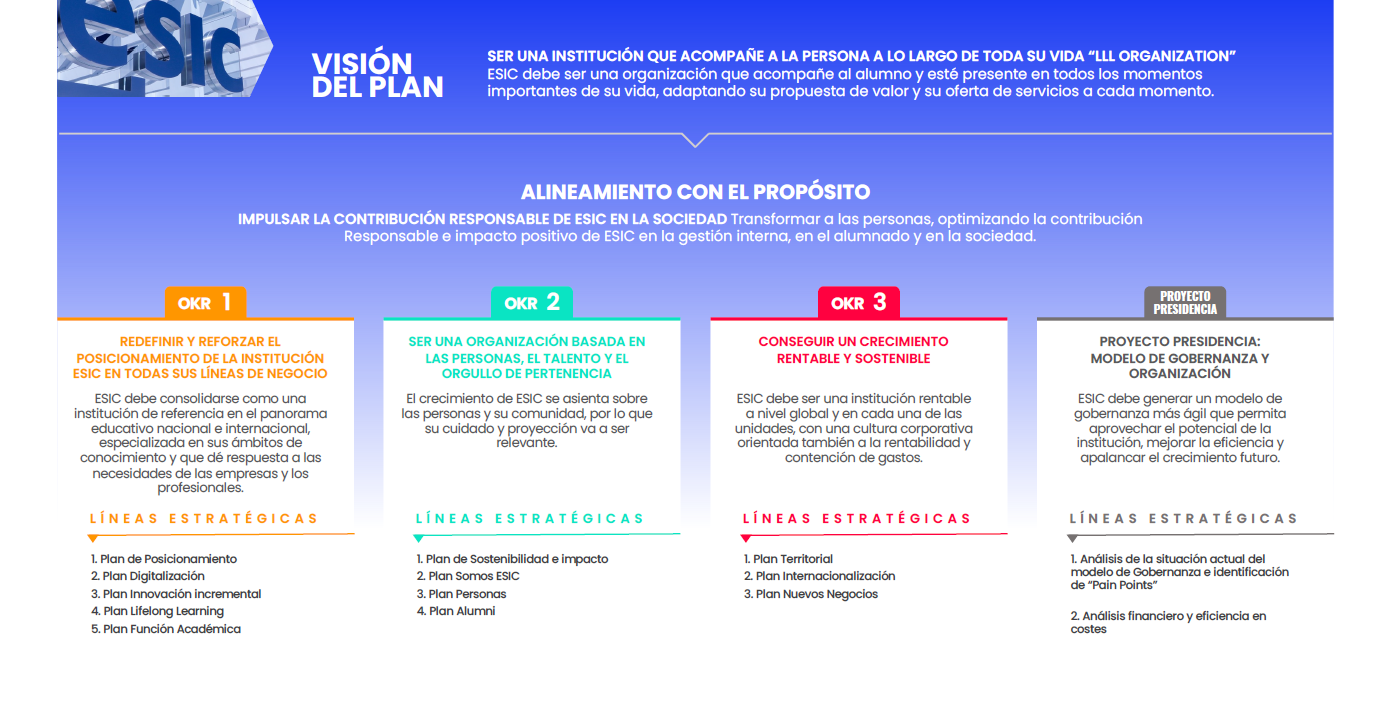
MORE THAN AN EDUCATIONAL INSTITUTION
SPECIALIZATION
If you want to study Business, Marketing or Technology, we present the most specialized offer in these disciplines in Spain.
PROFESSIONAL DEVELOPMENT UNIT
We open the doors to the world and you can enjoy our lifetime employment opportunities.
ESIC
ENTREPRENEURS
If you want to start your business, receive advice or access to our business incubator, you are in the right place.
ESIC Alumni
You will be part of a community of more than 66,000 alumni around the world.
ICEMD,
INNOVATION INSTITUTE
A reference in innovation and vanguard. A driving force for the growth and development of those who will be the creators of tomorrow.
SOCIETY AND ESIC
Committed to training and ethics.
TRAINING
ONLINE
Learn Business, Marketing and Technology from anywhere in the world, at your own pace.